
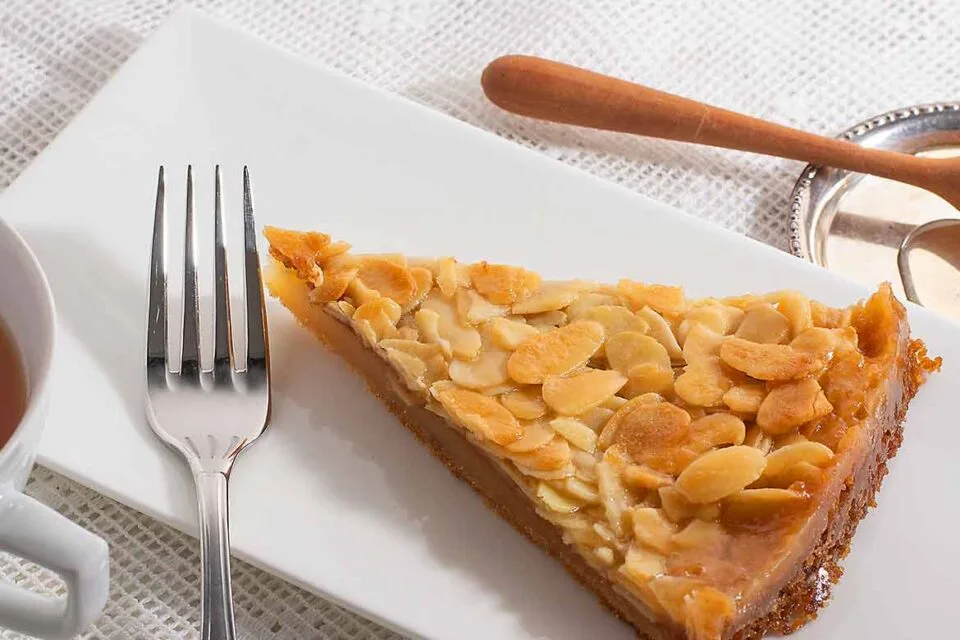
Tosca Cake made from almonds may sound very Italian but it is actually recipe from Scandinavia. Tosca Cake or (Toscakaka in Swedish) is delicious dessert at a party. Or have it just on your weekday break with tea at 5 o’clock. Cake will keep well in the fridge for a few days, but who can spare this delicacy?
You might also see this cake called Tuscan Cake in English — but “Tosca” has nothing to do with Tuscany. Nobody agrees on where the name really comes from. One theory ties it to Tuscan almond baking. The other — the one food historians tend to favour — points to Giacomo Puccini’s opera Tosca, which was wildly popular in Stockholm around the time the cake first showed up in the early 1900s. Either way, the cake itself is Scandinavian through and through, which is exactly why it makes such a good conversation starter at the coffee table.
What makes this cake work isn’t a long ingredient list — it’s the order you do things in. The sponge goes into the oven on its own first, just until it sets. Only then does the almond caramel go on top, and the whole thing goes back in at a higher heat until the topping turns deep golden and slightly crackly. Skip that first bake and the caramel sinks into raw batter instead of sitting on top of it. Get the timing right, and you end up with a soft, buttery base and a topping that shatters a little when you cut into it — closer to a giant almond florentine than a classic frosting.
It’s an easy cake to build a routine around: quick enough for a Tuesday afternoon with coffee, sturdy enough to bring to a party, and — as the original recipe rightly points out — hard to leave alone in the fridge for more than a day or two.
Tips for the Perfect Tosca Cake
The base needs to firm up before the topping goes on, but it shouldn’t be fully baked. After the first 20 minutes at 175°C (350°F), the centre should look set and spring back lightly when pressed — it will still look pale, and that’s correct at this stage.
Watch the caramel closely once it’s back in the oven at 200°C (400°F). Five minutes will give you a light golden crust; closer to ten minutes gets you the deeper amber colour and slight crackle most people associate with a proper Tosca Cake. Check every couple of minutes after the five-minute mark, since the sugar can go from golden to burnt quickly at that temperature.
Let the cake cool in the tin for at least 15–20 minutes before slicing. The caramel sets as it cools, and cutting into it too soon will pull it apart instead of giving you a clean slice.
No almond flakes on hand? Slivered or roughly chopped whole almonds work fine — just keep the total weight the same. If the caramel browns unevenly, rotate the tin halfway through the second bake instead of raising the heat further.
FAQ – Frequently Asked Questions
How long does Tosca Cake keep?
Kept covered in the fridge, it stays good for 3 to 4 days — the original recipe even points out that keeping it around that long is the hard part, not the cake itself. Let it come back to room temperature before serving; the caramel is nicer when it isn’t fridge-cold.
Can I make Tosca Cake ahead of time?
Yes. Bake the sponge base up to a day ahead and store it covered at room temperature, then make the caramel topping and do the second bake just before you plan to serve it, so the crust stays crisp.
Can I freeze Tosca Cake?
The plain base freezes well, wrapped tightly, for up to 2 months. The almond caramel topping is best made fresh, since it loses its crackly texture once frozen and thawed.
Can I change the topping or flavourings?
Almond is traditional, but hazelnuts work in the topping if that’s what you have. A little orange zest or ground cardamom in the sponge batter is a common Nordic variation if you want to move away from the plain vanilla base.
What wine should I drink with Tosca Cake?
Coffee is the classic pairing back home in Scandinavia — this is very much a “fika” cake. If you’d rather serve wine, a small glass of Vin Santo or other dessert wine is a fitting choice: an actual Tuscan dessert wine, traditionally poured with almond biscotti, that pairs neatly with the cake’s own almond caramel — wherever the name really came from.
See also torta della nonna
https://en.wikipedia.org/wiki/Torta_della_nonna
Tuscan Cake
Ingredients
Base of the cake
- 0.5 dl breadcrumbs
- 2 eggs
- 1.5 dl sugar
- 75 g butter
- 1 dl milk
- 1 teaspoon vanilla sugar
- 1.5 tsp baking powder
- 2 dl wheat flour
Coating
- 75 g butter
- 1 tbsp wheat flour
- 0.5 dl sugar
- 0.5 dl honey or syrup
- 2 tablespoons milk
- 100 g almond flakes
Instructions
- Preheat the oven to 175C. Take a large baking dish (28 cm in diameter).
- Spread 1 tablespoon of butter and the breadcrumbs on the baking tray.
- Whisk the sugar and eggs until smooth.
- Melt the remaining butter in a saucepan and pour in the milk. Keep warm.
- Add the milk mixture to the sugar foam add the spices and finally sift in the wheat flour. Mix well.
- Then pour the batter evenly into the baking dish and place in the oven for 20 minutes.
Almond coating
- Melt the butter in a saucepan. Add the sugar, milk, flour and syrup/honey and bring to the boil. Stir it occasionally to prevent burning. Finally add the almond flakes and stir again well.
- Remove the base of the Tuscan Cake from the oven. Raise the heat to 200C. Pour the coating evenly over the cake and leave it to gratinate in the oven for another 5-10 minutes until the top gets a nice brown colour.
- Allow the Tuscan Cake to cool for a while and serve with tea or coffee.
Notes
- Grease the tin well and dust it with the breadcrumbs specified in the recipe — this keeps the delicate base from sticking, since there’s no separate lining step.
- Store leftover cake covered in the fridge for up to 3–4 days; bring slices to room temperature before serving so the caramel isn’t hard.
- The plain sponge base freezes well on its own for up to 2 months. Make and add the almond caramel fresh after thawing, since it doesn’t freeze and re-crisp well.
Nutrition
This post is also available in:
 Suomi
Suomi
