
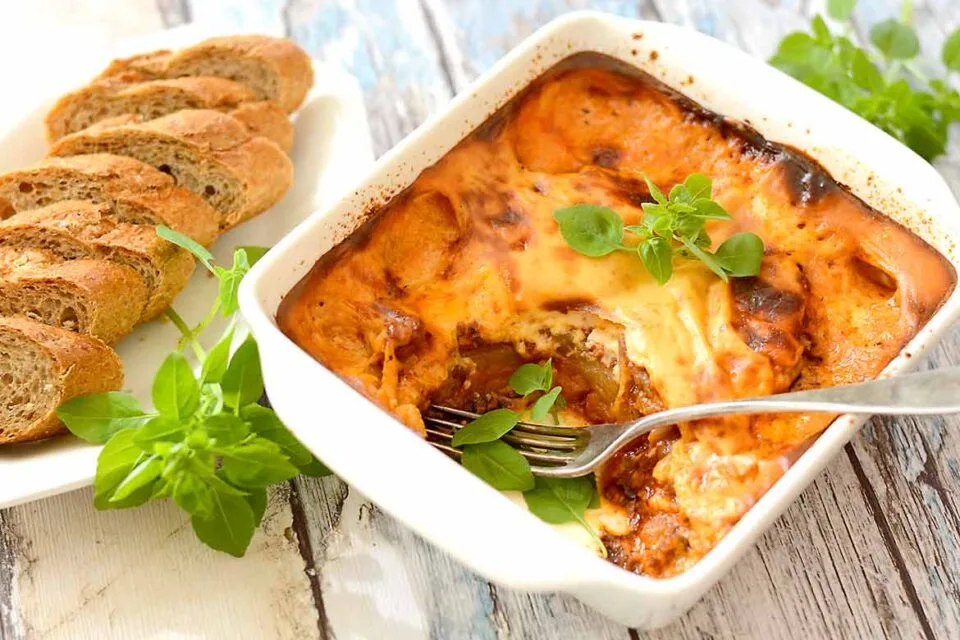
Moussaka is one of those dishes you should make in big batches. It only gets better in the fridge, and it’s easy to reheat in the oven. If you’re in a hurry, it’s a good idea to “sweat” the eggplants with salt to draw out excess liquid. This will shorten the baking time. Some say potatoes don’t belong in moussaka, but we beg to differ.
This layered bake is best for a weekend or a bigger crowd: prep takes about half an hour, and the oven does the rest. Potatoes and eggplant go on the bottom, a meat sauce seasoned with cinnamon and red wine vinegar in the middle, and on top a cheese sauce thickened with egg that bakes into a golden-brown crust.
Cinnamon may seem an odd spice for ground meat, but it’s a familiar one in Greek meat sauces. Half a teaspoon doesn’t make the dish taste like baking – it rounds out the acidity of the tomato and gives it its own Greek twist.
The history of moussaka – from an Arabic name to a Greek classic
Although it’s often called Greece’s national dish, the name comes from Arabic. The word musaqqa’a roughly means moistened or something that soaks up liquid, and it traveled through Ottoman Turkish into Greek and other Balkan languages. Dishes combining eggplant and meat already appear in medieval Arabic cookbooks.
The father of today’s Greek version is the French-trained chef Nikolaos Tselementes. In the 1920s he added a French béchamel sauce on top, aiming to make Greek food more European. Greek food historian Aglaia Kremezi has even said that before Tselementes, there was no moussaka as we know it today.
In neighboring countries, the dish is still quite different. In Turkey it’s often a stew-like dish made without white sauce, and in Lebanon it’s served cold as a tomato and eggplant dish that may even include chickpeas. In the Balkans, versions made with potatoes are common.
The trick: sweat the eggplant and let the dish rest
Eggplant holds a lot of water. If the slices go into the dish as they are, the liquid runs into the sauce while baking and the whole thing turns watery. Sprinkle salt over the slices, let them sit for about 30 minutes and pat off the released liquid with paper towels. You can also fry the slices in a little oil first, so they’re already soft and the baking time is shorter.
The other important step comes at the end. Don’t cut the dish straight out of the oven, or the layers will slide apart. Let it rest for at least 15 minutes, preferably half an hour. Served warm rather than hot, the pieces hold their shape and the flavors come through better.
Do potatoes belong in it?
Some Greeks say no. We disagree: potatoes make a sturdy base, soak up the juices of the meat sauce and stretch the dish to feed a bigger crowd. Potatoes are widely used in the Balkans, so we’re not alone on this.
FAQ – frequently asked questions
Can I make it ahead?
Yes, and it’s worth it. Bake it the day before, let it cool and keep it covered in the fridge. Reheat at 160 °C (320 °F) for about 30–40 minutes.
How long does it keep?
3–4 days in the fridge.
Can I freeze it?
Yes. Freeze it baked and cooled, in portions or as a whole dish. Thaw overnight in the fridge and reheat in the oven.
Which meat works best?
Traditionally lamb, but ground beef or pork works well too.
Which cheese should I use in the sauce?
In Greece, kefalotyri or graviera is common, but Emmental and Gouda work well.
Can I make it vegetarian?
Yes. Replace the meat with lentils or plant-based mince and use the same spices.
What wine goes with it?
A Greek red such as Agiorgitiko from Nemea or Xinomavro. A juicy Grenache or Syrah also works with the cinnamon and tomato.
Learn more
https://en.wikipedia.org/wiki/Moussaka
Moussaka
Ingredients
Vegetables
- 2 eggplants
- 5 large potatoes
Meat sauce
- 700 g ground meat beef, pork or lamb
- 1 large onion
- 4 cloves garlic
- 2 tsp dried oregano or pizza seasoning
- 2 dl tomato passata
- 1 tbsp honey
- 3 tbsp red wine vinegar
- ½ tsp cinnamon
- 4 bay leaves
- olive oil
- 2 tsp salt
- 1 tsp ground black pepper
Cheese sauce
- 2 tbsp all-purpose flour
- 2 tbsp butter
- 1 l whole milk
- 2 eggs
- 200 g grated cheese Emmental or Gouda
Instructions
- Peel and chop the onion. Sauté it in a generous amount of olive oil. Add the ground meat to the pan and brown it. Add the rest of the meat sauce ingredients and stir everything together. Season generously.
- Put the butter and flour in a saucepan. Heat and stir until smooth, but don’t let it brown. Pour in the milk and bring to a boil, stirring constantly. Remove from the heat and whisk in the grated cheese and eggs. Set the cheese sauce aside to cool.
- Peel and slice the potatoes. Wash the eggplants well and slice them into 1 cm (½ in) rounds. If you like, sweat the eggplant slices with salt for 30 minutes and pat them dry. Preheat the oven to 180 °C (350 °F).
- Layer eggplant and potato slices on the bottom of a baking dish, add the meat sauce, and top with more potatoes and eggplant. Pour the cheese sauce over everything.
- Bake for at least 1 ½ hours. Cover with foil if the top starts to brown too much. Test the potatoes with a wooden skewer.
- Let the moussaka rest for at least 15 minutes after baking, preferably half an hour, then dig in.
Notes
- Sweat the eggplant: sprinkle the slices with salt, let them sit for 30 minutes and pat dry with paper towels. This keeps the dish from turning watery.
- You can fry the eggplant slices in a little oil before layering, which shortens the baking time.
- Cook the meat sauce down properly. A runny sauce makes the dish watery.
- Let the cheese sauce cool for a moment before adding the eggs so they don’t scramble.
- Let the dish rest for at least 15 minutes after baking, preferably half an hour, so the pieces hold together.
- Reheated the next day, it’s often even better.
Nutrition
This post is also available in:
 Suomi
